Thursday, April 14, 2011

VG Meet DnD: The Crawler from the Dead Space Series

[Necromorphs are the reanimated corpses of the dead, reshaped into horrifying new forms by a mysterious curse.]

Crawler

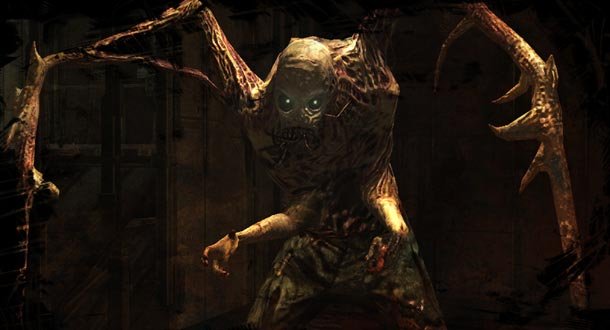
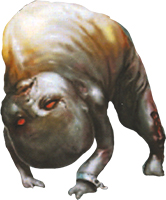
What appears to be a large infant slides forward on two arms and a single burly leg. Its head, which has been twisted backwards, stares vacantly ahead as it pushes its bulbous torso skyward, a torso that pulsates with a sickening yellow light.

Adults aren’t the only ones affected by the curse, children and even infants can be affected as well. The Crawler is an example of what happens when very young children or babies are infected by the curse. Their bodies are too small and weak to be of much use in combat. To offset this they transform into living bombs.

Strategies and Tactics

Crawlers have only one attack to make from the time they are created. They swarm opponents ahead of other necromorphs in a desperate suicide attack to weaken living foes or destroy them outright. They often do this by attacking in cramped quarters where there is less room for their prey to escape.

Ecology

Environment: These undead can technically be found anywhere. However due to the nature of their slow speed they are usually not found far from the site of their infection. Large concentrations of crawlers can be found in schools or nurseries.

Typical Physical Characteristics: A crawler resembles a bloated human child with ash gray skin offset with red or brown blood vessels. They are covered with dried blood and unknown ichor. Their heads have been twisted in a 180 degree angle and their back legs have fused into one single limb which they use to propel themselves forward in the manner of a caterpillar. Perhaps the most distinguishing feature is their torso, which has been twisted skyward and pulsates with a pale yellow light. The belly itself is the source of their exploding compounds.

Alignment: Crawlers are always neutral evil.

Typical Treasure

Crawlers do not keep treasure, they are usually too young to be adorned with jewelry or magical clothing. Such items, invariably, are destroyed when the creature explodes anyway. Occasionally, that is 5% of the time, they can be found with 1/10th of standard treasure in assorted coins from belt pouches or pockets they had on them before their infection. A crawler with such treasure which explodes invariably scatters the wealth across the combat area. 

For Player Characters

A player can summon a crawler to his service with the summon undead I spell. 


Also the crawler's explosive sac can be removed using the Survival skill and then used as a weapon

Crawler                                CR 1/6
Always NE Tiny undead
Init +3; Senses darkvision 60ft; Listen +1, Spot +1
Languages understands creator's orders; understands telepathic commands


AC 15, touch 15, flat-footed 12
    (+2 size, +3 Dex)
hp 3 (1/2 HD) see kamikaze burst
Immune undead immunities
Fort +0, Ref +3, Will +0


Speed 10 ft (2 squares)
Melee --
Space 2 ½ ft; Reach 0 ft
Base Atk +0; Grp -2


Abilities Str 6, Dex 17, Con --, Int 2, Wis 6, Cha 12
SA kamikaze burst
SQ strategic dismemberment, undead traits
Feats Ability Focus (kamikaze burst)
Skills Hide +13, Listen +1, Spot +1
Advancement none


Kamikaze Burst (Ex) As a standard action a crawler can generate an explosion which effects its squares and every square adjacent to the crawler. Creatures struck by the explosion take 1d6 damage (DC 13 half). The crawler drops to 0 hit points and is destroyed as part of this attack. If a crawler is destroyed through damage other than strategic dismemberment it will automatically initiate a kamikaze burst as a free action.

Strategic Dismemberment (Ex) A crawler can be destroyed without activating its kamikaze burst by decapitating the head or leg (AC 17). If this is done then the sac can be salvaged with a DC 15 survival check. A failed survival check results in the detonation of the sac.


Crawler Lore
Characters who have ranks in Knowledge (religion) can learn more about crawlers. When a character makes a successful skill check, the following lore is revealed, including the information from the lower DCs.

Friday, April 8, 2011

VG Meet DnD: The Leaper from the Dead Space Series


[Necromorphs are the reanimated corpses of the dead, reshaped into horrifying new forms by a mysterious curse.]

Leaper

The undead creature growls menacingly. It crawls forward on two massive forearms, it’s tail twitching violently behind it.

Like the Slasher the Leaper fights on the front lines for the curse, often serving as a scout. Leapers are created when a human body is tainted by spores released by the necromorph growth known as The Corruption. When an intact humanoid body is infected by the curse its body undergoes a wicked transformation. In the case of the leaper its internal organs, particularly the intestines, are fused together with the legs into a massive tail tipped with a deadly scythe.

Strategies and Tactics

A leaper fights using hit and run tactics, charging in and out of combat to make full use of it’s pounce and improved grab abilities.

Ecology

Environment: As undead Leapers have no natural habitat. However they are best suited for use in areas that offer plenty of spots for ambush and enough room for them to rush to and from during combat such as the intersections of large sunken passages.

Typical Physical Characteristics: Leapers resemble the mortals they were in life but with two major differences: their legs and innards have fused together to form a long sinuous tail tipped with a wicked bone scythe, and their jaw has split vertically and now sports four wicked fangs on each corner.

Alignment: Leapers are like their fellow necromorphs, always evil.

Typical Treasure

Because they ignore the possessions of their prey leapers have half standard treasure for their challenge rating. This treasure often takes the form of weapons which have become logged in the creature during past fights.

For Player Characters

A spellcaster of 7th level of higher can create a leaper using the create undead spell. Doing so requires the intact corpse of a medium humanoid which has been dead for no longer than two days.

Leaper                            CR1
Always NE Medium undead
Init +4; Senses darkvision 60ft; Listen +2, Spot +2
Languages understands creator’s orders; understands telepathic commands

AC 14, touch 14, flat-footed 10; Dodge, Mobility
    (+4 Dex)
hp 12 (2 HD); fast healing 5
Immune undead immunities
Fort +0, Ref +4, Will +2

Speed 30 ft (6 squares), climb 20 ft (4 squares)
Melee tail-scythe +3 (1d8+2) and
    bite -2 (1d6+1)
Space 5 ft; Reach 5 ft
Base Atk +1; Grp +3


Abilities Str 14, Dex 19, Con --, Int 6, Wis 10, Cha 5
SA improved grab, pounce
SQ strategic dismemberment, undead traits
Feats Dodge, Mobility*
Skills Climb+10* Hide +4, Jump +9*, Listen +2, Move Silently +6, Spot +2,
Advancement 3-15 HD (Medium)

Fast Healing (Ex) Damage dealt to a leaper’s limbs cannot be healed by it’s Fast Healing ability. See Strategic Dismemberment below.

Feats Leapers have Mobility as a racial feat.

Improved Grab (Ex) To use this ability, a leaper must hit with a bite attack. It can then attempt to start a grapple as a free action without provoking an attack of opportunity. If it wins the grapple check, it establishes a hold and knocks the opponent prone.

Pounce (Ex) If a leaper charges a foe, it can make a full attack.

Skills Leapers have a +5 racial bonus on Jump checks and take no negatives on their jump checks due to speed. It also has a +8 racial bonus to climb checks.

Strategic Dismemberment (Ex) The arms and tail of a leaper can be attacked independently of its main form (AC 16). Each appendage has a third of the leaper’s total hit points and damage dealt detracts from the creature’s total hit points. This damage cannot be healed through its Fast Healing ability. Once an appendage’s hp reaches zero it is destroyed resulting in a penalty that lasts the rest of the fight. If an arm is destroyed the leaper’s speed decreases by 15 ft (3 squares) to a minimum of 5 ft (1 square) if both arms are destroyed. If the tail is severed the leaper loses the use of its tail-scythe attack.


Leaper Lore
Characters who have ranks in Knowledge (religion) can learn more about leapers. When a character makes a successful skill check, the following lore is revealed, including the information from the lower DCs.

Monday, April 4, 2011

VG Meet DnD: The Slasher from Dead Space


[Necromorphs are the reanimated corpses of the dead, reshaped into horrifying new forms by a mysterious curse.]

Slasher

A humanoid figure staggers forward. It is covered in blood and ripped flesh. From its back jut forth two sinewy limbs which end in wicked scythes of sharpened bone. Its dead eyes stare at you, and suddenly it charges forward while it pulls its shoulder-scythes back for a decisive blow.

Slashers are footsoldiers for the curse. They are created when a human body is tainted by either an Infector (another type of Necromorph) or by spores released by the necromorph growth known as The Corruption. When an intact humanoid body is infected by the curse its body undergoes a wicked transformation. In the case of the Slasher its internal organs, particularly the intestines, are used with some of the host’s bones to produce a dangerous set of scythes that are the creature’s namesake.

Strategies and Tactics

Slashers prowl near the place they were killed looking for more people to kill. If time and the terrain permit they will stalk a victim and then attack from hiding. To begin an engagement they will charge a single opponent, attacking with their shoulder-scythes.

Ecology

Environment: As a subject of the curse slashers can exist anywhere. However, they are often found in out of the way temples or ancient ruins.

Typical Physical Characteristics: Slashers remain humanoid in form and only slightly shorter than they were in life. A typical specimen resembles a mortal whose skin has been partially flayed, with massive scythe like appendages jutting from its back which curve forward over the shoulders. It uses these natural weapons along with a vicious bite from the remains of its upper jaw to dispatch opponents. The creature tends to be shrouded in the vestiges of the ensemble it wore before its infection.

Alignment: Slashers are corrupted creatures who serve as extensions of an evil curse. As such they are universally evil.

Typical Treasure

Slashers don’t collect treasure, however they can be often found still carrying the remnants of what they had one them when they were infected. Slashers have half standard treasure for their challenge rating, often in jewelry, clothing or other adornments that can be found among the creature’s remains. Alternatively the treasure may be discovered amongst the carnage left in the creature’s wake.

For Player Characters

A spellcaster of 7th level of higher can create a slasher using the create undead spell. Doing so requires the intact corpse of a medium humanoid which has been dead for no longer than two days.

Slasher CR1
Always NE Medium undead
Init +4; Senses darkvision 60ft.; Listen +3, Spot +3
Languages understands creator’s orders; understands telepathic commands


AC 14, touch 14, flat-footed 10
(+4 Dex)
hp 10 (1 HD); fast healing 5
Immune undead immunities
Fort +0, Ref +4, Will +3

Speed 30 ft (6 squares)
Melee 2 scythes +3 each (1d4+3) and
bite -2 (1d6+1)
Space 5 ft; Reach 5 ft
Base Atk +0; Grp +3

Abilities Str 16, Dex 18, Con --, Int 4, Wis 12, Cha 6
SQ strategic dismemberment, undead traits
Feats Toughness
Skills  Hide +4, Listen +3, Move Silently +4, Spot +3
Advancement 2-15HD (Medium)

Fast Healing (Ex) Damage dealt to a slasher’s limbs cannot be healed by it’s Fast Healing ability. See Strategic Dismemberment below.

Strategic Dismemberment (Ex) The legs, scythes, and head of a Slasher can all be attacked independently of the main form. They each have a fifth of the Slasher’s total hp and damage dealt to the legs, head, or scythes is taken from the creature’s total hit points and can also not be healed via its Fast Healing ability. The AC to hit one of the legs, head, or scythes is 16 (Slasher’s AC + size bonus). If any of the body parts are destroyed the slasher suffers a penalty: A destroyed leg reduces the creature’s speed by 10 ft (2 squares), when a scythe is destroyed the slasher loses the use of that attack, finally the destruction of the head blinds the creature. If both the slasher’s scythes are removed the creature dies instantly.


Slasher Lore
Characters who have ranks in Knowledge (religion) can learn more about slashers. When a character makes a successful skill check, the following lore is revealed, including the information from the lower DCs.


Wednesday, March 30, 2011

VG Meet DnD: The Ecology of the Necromorphs


"Their outlines were human, semi-human, fractionally human, and not human at all--the horde was grotesquely heterogeneous." --H.P. Lovecraft, "Herbert West--Reanimator"


[Below you'll find an ecology article written about Necromorphs, undead of the popular video game series "Dead Space". Following up on this article will be 3.5 write-ups of several different necromorphs. While converting them to 3.5 D&D I necessarily had to make some changes to their backstory, but for the most part they operate similarly to how they do in the games. You don't need to have played the Dead Space games, however, to use these deadly undead predators in your games. Enjoy.]

Lands should remain unplundered when their secrets are better left undisturbed. Buried deep beneath the surface of the earth, possibly having fallen from the stars aeons ago, lies the Marker and the creatures that follow it like a plague...the Necromorphs.

Necromorphs are the reanimated corpses of the dead, reshaped into horrifying new forms by a mysterious curse related to the Marker. They have no memories of their former life and are highly aggressive. Only one purpose guides the steps of the Necromorphs. “Spread the curse.”

HISTORY OF THE NECROMORPHS

Because few know of their existence, and by extension the Marker, there is little information on Necromorphs. What is known by the reclusive scholars, or the mysterious cultists who worship the Marker, comes from an incident outside the mining town of Aegis-Sven. The exact location of Aegis-Sven has been lost with time, as well as most information concerning the incident.

What is known was compiled by Sage Stross from the varied notes of the late Archmage Altman, who witnessed the event firsthand. While surveying the area for new ore deposits a group of miners uncovered an ancient artifact that had been buried beneath the surface and left undisturbed for countless years. The miners informed their superiors who sent for a nearby cabal of wizards and scholars to examine the mysterious object.

The Marker, as it came to be called, resembled a hunk of strange stone split in two halfway down with the two pieces twisting about each other like grasping spires. Its surface is covered in bizarre sigils and when touched it the thing hums almost inaudibly with some sort of pattern.

It was quite a find, so the cabal brought more of their kind to the site and requested lodging and assistance from the mining guild until they could assess the artifact’s purpose and worth. The guild agreed. Thus the scholars and wizards began their examination in earnest and the miners returned to their work in other tunnels.

The life of a miner is difficult: long hours underground, chipping away at solid rock with the risk of tunnel collapse, and the release of deadly gases from the interior of the world hangs over workers like a shroud. Perhaps it was because of this that no one paid attention to the early accounts of violence among the mining camps, many of which led to injury or death. When the suicides started some finally started to speak up about the peculiar change in behavior of the town’s inhabitants.

Citizens started disappearing and miners whispered of how the caves were cursed, all while the sages and wizards worked yet to unravel the mysteries offered by the strange artifact they began calling “The Marker.” The sigils from the surface of the Marker started appearing around town, written by people who had never had contact with the thing. Folk began to complain to each other of constant headaches and sleepless nights in which nightmares were filled with indistinct forms or the familiar voices of those already passed away.

The miners continued to dig deeper, chopping at the earth in search of resources, while the world around them continued on its dark path. Talk of the events it was done in hushed tones, and, following the guidance of their dreams, many began to twist two of their fingers around each other when scared or threatened in a mock replica of the Marker itself. The miners had cause to be afraid, a mysterious growth resembling flesh and sinew began to spread out from the deeper mines.

The cabal’s research consumed them, and they split into two camps. Some believed the Marker to be the instrument of some divine force and began to speak in sibilant tones about an event they called “Convergence”. These were the first Unitologists, believers in the “truth” of the Marker, who claim that through the teachings of Unitology all things will become as one. That the Marker would bring an end to war, to horror, to pain, and ultimately a transcendence over death itself.

None who lived in Aegis-Sven saw it coming. One day many of the Unitologists committed suicide in a holy sacrifice to their new god in the Marker. The bodies were quickly carried from the area and lain aside in a supply building until a mass grave could be made. One of the remaining wizards went mad and began slaying the miners as they worked, slinging powerful spells and screaming about monsters until he was brought down by the collapse of one of the tunnels. Many citizens left, never to return. Those who remained quickly discovered the folly of their action.

When the grave was finished, now made larger for the addition of the miners, those who came to the supply building to collect the bodies discovered none. Shortly thereafter screams could be heard coming from the miners still in the caves. Undead monstrosities started pouring out of the tunnels, slaying all who stood in their path. Worst of all, those slain were soon found walking again, their bodies twisted into instruments of violence, the life in their eyes forever replaced by deadly ferocity.

It took all the strength of Archmage Altman and the remainder of his cabal to lock the creatures away and contain the incident. Great spells were weaved to bury all of Aegis-Sven beneath the surface so that none could find it again and release the horror of the Marker. But what is now buried may someday be uncovered. Like the Marker in the tunnels beneath it, Aegis-Sven awaits discovery by the foolish and unlucky.

LIFE CYCLE OF THE NECROMORPH

As undead creatures the necromorphs are not born, they are made. The Marker gives off a subtle pulse which eventually animates dead tissue into a single fleshy mass known as “Corruption”. Corruption produces spores which when released onto corpses (or when ingested by living humanoids who die before the removal of the spores) evoke a remarkably quick change in the host. The body twists and changes, bones and sinew shifting to create a deadly undead soldier.

Most of these corpses turn into the two necromorphs known as Slashers or Leapers. Some corpses, however, turn into a specialized creature known as an Infector or even deadlier creatures. The Infector is able to spread the curse by implanting spores directly into corpses. The rest of the curse’s undead servitors go out to hunt and slay living beings to create hosts for the spores. Then they drag them into piles near the Corruption, or leave them for Infectors to find.

Although such an event has not been allowed so far to pass, there is a stage in the life cycle of necromorphs known as Convergence. Theories posit that Convergence begins when the population of a hive of necromorphs expands to unheard of levels, and somehow involves a communion with the Marker.

PSYCHOLOGY AND SOCIOLOGY OF THE NECROMORPH

Necromorphs are extremely aggressive creatures, going out of their way and enduring great bodily harm or even assured destruction for the chance to kill living creatures. Essentially, this presents itself as a powerful drive for procreation. Though necromorphs cannot procreate in any normal fashion they slay living creatures for the curse to infect and transform, thus growing their numbers. They accomplish this task through a variety of means that reveal an amount of primitive intelligence. They have been known to set up ambushes or wait for a target to look away before attacking. They prefer to fight in a pack, utilizing hit and run tactics and guerrilla warfare.

But other than a necromorph type called “Stalkers” they don’t seem to communicate with each other. The audible sounds they do make don’t seem to have any underlying meaning, they don’t communicate by touch or signal and apparently don’t give off any chemical cues either. As mentioned above Stalkers are the exception to this rule, seemingly communicating by chittering noises the strength of enemy numbers, their position and even their combat strength. Most necromorphs seem to communicate through some sort of innate telepathy granted them by the powers of the curse.

When not engaged in combat necromorphs exhibit a variety of behaviors. They may wander aimlessly until they find another living target, or stand in place until a target finds them. As mentioned above some will carry corpses to The Corruption or into piles for an Infector to find, whereas still others will lie upon the ground and remain silent, playing dead, as an ambush for luckless bystanders.


PHYSIOLOGY OF THE NECROMORPH

Necromoprhs come in a variety of different forms and types, yet there are still many things common to the creatures as a whole. Unlike some undead varieties necromorphs are not driven by a supernatural hunger; although they may chew on opponents with their distended jaws this is only as an offensive tactic, and not indicative of a need to feed.

Likewise necromorphs have no need to sleep, and even those with working respiratory systems have no need to breath, although it seems they have a preference for some gases over others (as evidenced by the Wheezer). Necromorphs have no discernable anatomy and because of their undead nature are extremely difficult to destroy. In fact, while they may be destroyed in the conventional means, the best way to defeat them is through the process of dismemberment.

DISMEMBERMENT

As undead creatures necromorphs do not suffer from the same weaknesses that apply to the living. They do not need to breathe, sleep or eat. Their bodies are also highly resistant to attacks and some are even known to have regenerative properties. Thankfully they are known to possess one weakness, dismemberment.

Many necromorphs will die if only a few of their limbs are removed, or indeed if a specific limb is removed. While there is currently no theory as to why this is (those who have encountered the beasts had more important things on their minds than research). Attacking the same limb until it is destroyed not only ensures a quicker defeat of the necromorph but also limits their abilities with each successful dissection.

However, there are some necromorphs who have particular areas that should not be attacked: exploding sacs that damage those nearby, pustules that spew acid, or flesh that hides yet more monstrosities to name a few examples. These necromorphs become more dangerous if mishandled.

Necromorphs in Eberron

Inside the Silver Flame is an ancient evil which works towards its insidious tasks by manipulating the Voice of the Silver Flame. This taint, known as the Duality, is to blame for the Marker’s creation. The Necromorphs are one of its many projects. No one knows where the remains of Aegis-Sven lie, but rumors say the town was in the Mror Holds. Strange undead creatures are still occasionally seen in the area.

Knowledge of the Necromorphs

The following table shows the results of a bardic knowledge or Knowledge (religion) check related to necromorphs. Because of the variety of necromorphs the DCs vary by the necromorph being examined.

This table assumes that necromorphs are well known in your campaign. If you want them to be rare as they are presented here than increase the base DC by five. (IE 10 + Cr becomes 15 + CR, etc).