Showing posts with label Zelda. Show all posts

Sunday, November 29, 2009

VG Meet Dnd: The Golden Goddesses of Zelda

*The Legend of Zelda and all official images are property of Nintendo


As you may have already seen Mariah has started statting out races from the Legend of Zelda game series. I've decided to jump in on the fun from time to time and my first contribution is a write-up of the three Golden Goddesses. While these deities can be worshiped by anyone, they work best with the Zelda races, like the Hylian or the Rito. Below you'll find a write up for each god, as well as as a write up for the pantheon as a whole. Each entry also includes a new Channel Divinity feat, complete with power card, and a list of domains (introduced in Divine Power) that fit each entry.

The Golden Goddess
Good
The Golden Goddesses are a group of three related deities collectively representing Hyrule, but focusing on the virtues most important to that culture-courage, wisdom, and power. In Hyrule the Golden Goddesses are the most worshiped deities. They are worshiped by a variety of races and professions-human farmers, hylian nobles, and zora musicians to name a few. Almost everyone offers prayers to the Golden Goddesses as a collective group, only offering prayers to an individual sister when they need help with something specific. For example, a judge might offer up a prayer to Nayru before a trial, and a warrior might ask for the guidance of Din during a battle. As a whole, the Golden Goddesses exhort their followers to:
  • Do not resist the current of destiny, to refuse its call is to deny yourself our greatest gift.
  • Strive for balance in life. Courage, wisdom, and power are nothing alone, but together can make wishes come true.
  • Do not abuse the gifts of the goddesses, to do so is to inspire retribution.
Golden Touch [Divinity]
Prerequisite: Channel Divinity class feature, must worship the Golden Goddesses
Benefit: You gain the Channel Divinity power Golden Touch


Domains: Creation, Fate, Protection

Din
Unalinged
One of the Golden Goddesses, Din represents the the virtue of power. With her might she created the earth and through her comes the dance of seasons. Like her sisters Farore and Nayru she is worshiped throughout Hyrule, however the vast majority of her worshipers are either warriors or goron. In iconography Din is alternatively shown as either a hylian or a gerudo woman with both palms open with small flames rising up from her open palms. Surprisingly in some pictures she also has a snake curled about her neck ready to strike. She encourages her worshipers to:
  • Achieve and maintain physical perfection.
  • Test your prowess in contests and in battle. May the strongest prevail.
  • Respect Fire, it is an invaluable tool and a powerful weapon.
Din's Fire [Divinity]
Prerequisite: Channel Divinity class feature, must worship Din
Benefit: You gain the Channel Divinity power Din's Fire


Domains: Earth, Strength, Sun

Farore
Good
One of the Golden Goddesses, Farore exemplifies the virtue of courage. She is the creator of life and the patron deity of Hyrule's staunchest defenders. Like her sisters Din and Nayru, she is worshiped throughout Hyrule, mostly though by the various fae creatures such as the kokiri. In images she is most often portrayed as a hylian woman with long flowing green hair. She espouses her followers to:
  • Act with valor in all things.
  • Nurture and respect life.
  • Watch for and defend against tyranny in all its forms.
Farore's Wind [Divinity]
Prerequisite: Channel Divinity class feature, must worship Farore
Benefit: You gain the Channel Divinity power Farore's Wind


Domains: Freedom, Life, Luck

Nayru
Lawful Good
One of the Golden Goddesses, Nayru represents the virtue of wisdom. As her final act before leaving this realm she gave forth the body of law. Like her sisters Din and Farore, she is worshiped throughout Hyrule, mostly by soldiers, nobility, and others who protect civilization. In art she is often portrayed as a hylian woman with long blue hair, with a single shock turned upward towards the sky. Her faithful should:
  • Understand and follow the law.
  • Bring the light of civiliation to the shadows of the world.
  • Study the past and the present, in this way you can foresee what is to come.
Nayru's Love [Divinity]
Prerequisite: Channel Divinity class feature, must worship Nayru
Benefit: You gain the Channel Divinity power Nayru's Love


Domains: Civilization, Justice, Knowledge

Thursday, November 12, 2009

4th Edition Dnd Races of Zelda: Rito


Rito

RACIAL TRAITS
Average Height: 5'4" - 6'0"
Average Weight: 140-200 lb.

Ability Scores: +2 Dexterity, + 2 Charisma
Size: Medium
Speed: 6 squares
Vision: Low-light

Languages: Hylian [Common]
Skill Bonuses: +2 Acrobatics, +2 Perception
Light on your Feet: You can shift in difficult terrain
Aerial Acrobat:
You gain a + 1 bonus to your Reflex Defense
Rito Flight: You can use Rito Flight as an encounter power


Play a rito if you want...
◆ To be able to take to the sky above your foes
◆ To be a member of a close knit tribe that reveres a powerful dragon
◆ To be a member of a race that favors the bard, sorcerer, and rogue classes

Physical Qualities:
Ritos are very bird-like in appearance, and are believed to have evolved to their current state from another race. Their most prominent features are their large yellow beaks where a human's nose might be and an expansive set of wings under their arms. These wings fold and tuck neatly when not in use and are usually off-white with brown at the tips of the feathers. All Rito have red eyes and can have pale to tan skin, and white, brown or red hair, though white is the most common. They also have very small pointed feet like those of a bird, with small but still capable talons. Rito often wear lose, colorful robes which do not constrict their movement or flight. They wear few other adornments other than a belt and a bag to carry things while in flight. White, reds, golds and browns are popular colors in their garb and homes.

Playing a Rito:
The Rito live outside of the cities in mountainous terrain and can convert caves or low cliffs into suitable dwellings. Young Rito are called fledglings before they have gained the ability to fly. When they are ready, a fledgling will undertake the journey to the lair of the Rito patron exarc, the sky spirit Valoo. Once there Valoo bestows upon the fledgling one of his scales, which enables them to grow wings and fly. This is the Rito's most time-honored tradition and to refuse to go to Valoo, either from fear or inability, brings great shame to a Rito. Most Rito can only fly a short distance before becoming fatigued, but some more experienced and older Rito can fly over long distances and even carry other small humanoids for a short time. The Rito follow a tribal leader who is generally appointed by bloodline but they do not follow many strict laws other than cultural traditions. Rito are very competitive and will devise games to challenge themselves mentally and physically and compare their relative strengths.

Rito histories speak of a time when the race was flightless and had to use ropes and other tools to navigate the dangerous mountain terrain. Then the Rito found the sky spirit Valoo, who appeared as a gigantic and fearsome red dragon. Valoo granted the Rito his magical scales so that they may take to the skies like himself. Thus, the Rito are extremely grateful and reverent towards Valoo and would never think to disrespect him. The tribe will appoint a young female to serve as Valoo's attendant, to ensure that all sacred rites are performed perfectly. Traditionally the attendant will spend most of her time near Valoo and play the harp to calm his easily tripped temper.

While they do not live with other races, Rito enjoy traveling and have a penchant for becoming messengers due to their ability to cover vast distances quickly and without many provisions. Rito may seem aloof at first, but they quickly warm up to others who are friendly towards them and will welcome them into their homes. Many Rito are trained in combat from a young age, as they find it is best to always be prepared for any kind of attack. A good portion of the tribe will serve as guards to protect the Chieftan, the fledglings and the entrance to Valoo's lair. Even in small numbers the Rito are very capable at defending themselves and their homes because of their constant competition with each other to become better warriors.

*"Skett and Akoot" Original art by Hillary Esdaile, check out her website and deviantart page!

Rito Characteristics: carefree, loyal, competitive, perfectionist, traditional, outgoing, reverent

Example Rito Names:
Male: Akoot, Basht, Hoskit, Ilari, Koboli, Namali, Pashli, Skett
Female: Beroke, Dakapo, Eliji, Harmonee, Kadenz, Kapela, Oktev, Opari

Examples of Rito in the Legend of Zelda: Medli, Komali, Quill, Rito Chieftan

Background and History in the Points of Light Campaign Setting:
No one remembers what the Rito were like before the great dragon Valoo settled in their region, but what is known is that rather than rely on dragonborn or kobolds for protection and company, Valoo elevated a fledgling race into what is now the modern Rito. For the gift of flight, and his ultimate protection from the dangers of the world outside their mountainous homes, the Rito care for and faithfully serve the dragon Valoo. When other races were striving to build and maintain vast empires, the Rito sought only to exist, in peace with themselves and the land around them. Recently however, with darkness pushing in on the boundaries of their land some Rito have begun to leave their ancestral homes. Envoys for peace and travelers seeking to unite the various points of light, the path these Rito travel may just end up protecting their home and traditions, but forging a pact that will ensure the safety of various humanoids and their homes.

Rito Lands in Points of Light Campaign Setting:
Most Rito live in a mountain range dominated by an impressive volcano. They create homes in hallowed out bedrock and caves in the mountains. They use the surrounding lands around their home for harvest and consider it as much their home as the rocky croppings from which they keep their vigil. While non Rito are welcome in Rito territory they may find various portions of their lands inaccessable without the ability to fly or an impressive skill at climbing.

For more information about the Rito: http://zelda.wikia.com/wiki/Rito

The Legend of Zelda and all official images are property of Nintendo

Sunday, October 25, 2009

4th Edition Dnd Races of Zelda: Hylian

Over the following weeks I will be posting descriptions and racial traits for the most famous and best loved races in the Zelda Universe. I'll start today with the most obvious and famous: the Hylians, a race that is distinctive and apart from humans. More races will follow (including Gorons, Zora, Shiekah, Gerudo and many others!) as well as sample characters to match various campaigns in the Zelda Timeline. For now, you can simply insert these races to flavor your current 4th edition campaign and add more options for your players without buying additional supplements. Enjoy!


Hylian

RACIAL TRAITS
Average Height: 5'8" - 6'4"
Average Weight: 135-220 lb

Ability Scores: +2 Wisdom, + 2 Charisma
Size: Medium
Speed: 6 Squares
Vision: Normal

Languages: Hylian [Common]
Skill Bonuses: +2 Insight, +2 Religion
Goddesses' Protection: You have resistance radiant equal to 5 + 1/2 your level
Chosen People: You gain a +2 bonus to death saving throws
Alleviating Strike: You can use alleviating strike as an encounter power


Hylians are known as "the chosen people" of Hyrule. With their divine gifts, they excel at magic and leadership. This tends to make them very proud and many believe that humans are jealous of their favored status.

Play a Hylian if you want...
  • To have a proud heritage and strong connection with the gods
  • To have a burning ambition and strong belief in your own destiny
  • To be a member of a race that favors the cleric, paladin, invoker and avenger classes
Physical Qualities:
Hylians look very much like Humans except that they have protruding pointed ears as their main identifying feature. It is said they have longer ears so that they can hear the voices of the gods. Hylians tend to be taller and slimmer than the average human, with well defined bone structure and exceptional grace. Hylians also tend towards fair skin, blonde or red hair and blue eyes but can have any of the colors of the Human spectrum in addition to some rare members having unnatural shades such as purple or blue hair.

Hylians wear simple clothing with bright elaborate embroidery often displaying sacred and historically significant images. Regal blues, purples and pinks are common. Females wear an abundance of intricate gold jewelry with the triforce, the symbol of their godessess being most prominent.

Playing a Hylian:
Hylians tend to live in cities near the centers of power and are often in charge of local affairs or at the very least involved. They live simply and practically but that does not mean that they don't enjoy the finer things in life without being gaudy. Hylians can have a wide variety of professions but they excel at artistry and crafting. Due to their natural affinity with handling animals they also tend to raise and breed them and horses are an especially important part of their lives.

Hylians believe that they were particularly created by the three Goddesses which they worship: Din, Farore and Nayru. Each chooses one of the three Goddesses and the virtue she embodies (Power, Courage and Wisdom respectively) from a young age as a paragon to guide them. Hylians who venerate Din seek power in different forms whether it be physical, magical or political. They are very driven and will constantly try to increase their power for good or ill. Strong willed Hylians tend to choose Farore and try to live their lives without fear. They will charge into battle and refuse to yield no matter the odds and believe that with Courage they can accomplish their goals. Scholarly and intelligent Hylians honor Nayru as well as nobles, guards and leaders because she is said to have created the rule of law and reason. These individuals use their wisdom to lead, explore magical arts, heal the sick, and adventure to discover truth. Nothing will stop them in their quest for greater knowledge and they constantly seek to educate those around them.

Because of their belief in themselves as a chosen race of the Gods, Hylians tend to think lesser of the other races but that does not necessarily mean that they hate or subjugate them. Few Hylians take to outright xenophobia and most of them behave friendly and charitably to others, if perhaps too self-important. They live and work most often with Humans, being the closest to them physically, but they will adventure with most any of the traditionally benevolent races happily (Eladrin, Elves, Halflings, Dwarves, Gorons etc.) and are suspicious of the more violent and rare species (Dragonborn, Tieflings, Gerudo, Orcs, Moblins etc.)

Hylian Characteristics: proud, diplomatic, devout, valorous, charismatic, intuitive, idealist

Example Hylian Names
Hylians use simple one or two syllable names which are often passed down or significant in meaning
Male:
Auru, Fyer, Grog, Kafei, Mesa, Orca, Sakon, Shad
Female:
Agitha, Aryll, Astrid, Marin, Telma, Tetra

Examples of Hylians in the Legend of Zelda: Link, Zelda, Malon, King Daphnes Nohansen Hyrule, Anju

Background and History in the Points of Light Campaign Setting:
Around the campfires of the world and the hearths of city taverns stories are told of the magical kingdom of Hyrule. The land of Hyrule was both beautiful and bountiful, and blessed with peace. But of course, that peace would one day be shattered. A powerful villain arose and against his power the Hyrulian kingdom could not stand. Finally the Goddesses had to intervene, and buried the villain underneath a torrent of water, so much that the great kingdom of Hyrule sank beneath the waves.

Few Hylians alive truly remember what it was like to live in Hyrule, having had so many generations pass since the nation fell, but they do remember the glory of it. Filled with pride over their history, there is a saying that Hyrule will always exist in the hearts of her people.

Hylian Lands in Points of Light Campaign Setting:
Hylians have no land in the Points of Light, and are a rare sight in the vales. They often share lands with humans, although there exists the rare Hylian village or city district. These Hylian areas are filled with majestic architecture and fine craftsmanship in an attempt to pay homage to their glorious past, but they are an exception rather than the norm.

For more information about Hylians check out: http://zelda.wikia.com/wiki/Hylian
For more information about the Goddesses: http://www.zeldawiki.org/Goddesses

The Legend of Zelda and all official images are property of Nintendo

Saturday, August 22, 2009

VG Meet DnD: Sorceress Sisters Twinrova from The Legend of Zelda: Ocarina of Time


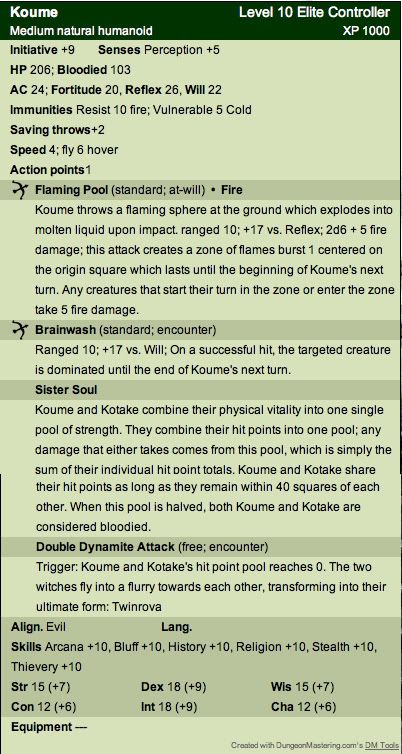
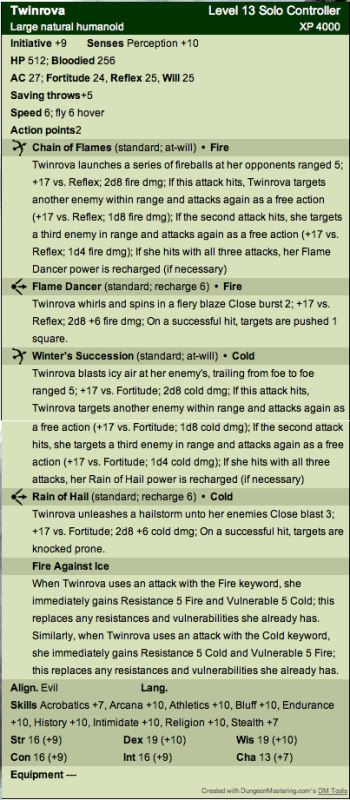
The "Sorceress Sisters Twinrova" or just Twinrova, refers to the iconic boss battle including the evil witches Koume and Kotake and their fused form Twinrova from the Spirit Temple in Ocarina of Time. Considered one of the best by fans of the series, Koume and Kotake use their opposing Fire and Ice abilities which must be reflected back unto them. What makes the battle so memorable, however, are the little nuances in the witches personalities which come alive while fighting them. From their opening cryptic words, Twinrova's embarassing wink, to their petty bickering at their defeat, these characters make great villains and an epic solo battle. The stats below (using Koume and Kotake followed by Twinrova) make up a solo level 15 encounter.


Koume
"With my flame, I will burn him to the bone!"

Koume is an ancient evil witch with powerful fire magic. Along with her twin sister, Kotake, they are collectively known as Twinrova.

Koume Tactics

Koume will want to remain in the air on her broomstick, as she is old and slow on the ground. In addition this will keep her out of harm's way from powerful melee fighters and allow her to manuever around freely to use her Flaming Pool power. She will want to use her Brainwash power on a weak willed but physically strong character. When Koume and Kotake are utilizing their Sister Soul hit point pool, both witches will physically flinch when one is attacked, as it is damaging both. Koume may also use her high Bluff skill to try and trick the party and feign surrender, using her high Stealth to launch a surprise attack.


Kotake

"With my frost, I will freeze him to his soul!"

Kotake is a decrepit evil sorceress with potent cold magic. Along with her twin sister, Koume, they are collectively known as Twinrova.

Kotake Tactics

Kotake prefers to take to the air for better maneuverability and to stay out of reach of melee combatants. She will use her Ice Sheet power whenever possible to keep her enemies still and make better targets for Koume's Flaming Pool. Kotake will use her Brainwash power on a weak willed foe soon after Koume as she will become jealous of her sister's slave and will want to make one of her own. Kotake may also use her acute Insight to play on her enemies' fears followed by Intimidate or Diplomacy to get her way.


Koume and Kotake Lore

A Character knows the following with a successful history or religion check

DC20 Koume and Kotake are ancient witches known for trying to resurrect evil deities to do their bidding. It is said that the two could raise massive armies of brainwashed men and women.

DC25 The two witches were often referred to collectively as Twinrova in historical/religious texts

A Character knows the following with a successful arcana check

DC20 Koume and Kotake are powerful sorceresses commanding the powers of fire and ice, respectively. It was thought that the two could merge into a more powerful ultimate being using their dark magic.

DC25 The amalgamate form of Koume and Kotake was called Twinrova


Twinrova

Twinrova is the result of Koume and Kotake's Double Dynamite Attack. She appears as a large, much younger woman, wielding a rod in each hand: one of flames and one of frost.

Twinrova Tactics

Twinrova may begin the battle using any of her abilities, depending on the formation of her enemies. If they are scattered around in all directions she will use either her Chain of Flames or Winter's Succession powers. If they are surrounding her closely she will drop to the ground to use her Flame Dancer power. Finally, if they are all in front, grouped closely together, she would use her Rain of Hail. Once her Flame Dancer and Rain of Hail powers are expended she will attempt to recharge them using Chain of Flames and Winter's Succession. Keep in mind her Fire Against Ice which will switch her resistances and vulnerabilities based on which type of attack she last used. The party may figure this ability out after a few trial and error rounds and use it to their advantage--if she is hit by the type she is resisting she will brush the attack off quickly but if she is hit by her weakness, she will cry out sharply.

Twinrova Lore

A Character knows the following with a successful history check

DC25 Twinrova is the fused entity of Koume and Kotake. The two witches are said to don this form only when they have no other choice. According to legend, Twinrova is impossible to defeat because of her shifting weaknesses and strengths.

A Character knows the following with a successful arcana check

DC25 Twinrova is the fused entity of Koume and Kotake. She uses both fire and ice magic and is said to be more powerful than the two witches are separately.


Using Twinrova in your 4th Edition DnD Campaign

Koume and Kotake, with their oddball personalities and penchant for brainwashing innocent bystanders, make a great recurring villain for a heroic-paragon campaign. The characters may first encounter the witches at a lower level where they fight one or both of them for a while before the witches flee into a portal, cackling with glee. The witches' ultimate goal may be to resurrect an evil deity or aspect of a deity, such as Orcus or Nerull. A close friend of the party may become brainwashed by the duo or could have been brainwashed from the start. Finally, at 15th level the party will be able to take care of them, feeling a great sense of accomplishment from defeating an ancient evil.


**The Legend of Zelda is property of Nintendo


Sunday, August 16, 2009

VG Meet DnD: The Rope from The Legend of Zelda


The snake-like Rope first appeared in the original The Legend of Zelda for NES, and has been used in all the top view 2D Zelda games. The Rope is a great minion for DMs who use a grid battle map in their games. Its linear attack pattern lends itself to a variety of unique encounters and situations either by themselves, or in a group with other monsters.

Rope

The rope looks like a normal snake but is the size of an average humanoid. When they sense an enemy they swiftly charge their aerodynamic forms in a straight line at the creature. They are generally weak, but their tendency to be found in dungeons in large groups makes them dangerous to the inexperienced adventurer.


Rope Tactics

The rope is able to attack a nearby enemy as soon as it moves into range with its unswerving charge power. However, a group of ropes attempting to ambush a party may delay their attacks until they can surround the group. As per usual, a rope may only charge enemies that are at least 2 squares away, and may only charge enemies in a straight square line (*see diagram below). When it is next to enemies it must rely solely on its bite power.


Rope Lore

A character knows the following with a successful Dungeoneering check

DC15: Ropes are snake-like creatures usually found in groups in large open rooms, waiting for an enemy to cross their line of sight so they can quickly charge their prey.


*In order to best explain the limitations of the unswerving charge power I have provided a sample battle situation


Here an adventuring party enters an open room and we will assume do not spot the enemies. Let the R counters be the ropes. Now, all ropes that are able to use their unswerving charge power will do so, interrupting the characters' movement. The charge being made by the ropes is represented by the black arrows. The ropes that do not qualify to use the move will not act until their initiative.

Now we have the setup after the ropes' immediate interrupts have gone off.

As you can see you could combine ropes with different shaped rooms to achieve certain goals, such as trapping the players in a narrow hallway, or pushing towards a more dangerous foe. You could always take a tip from Zelda and simply fill a room to the brim with them for a higher level encounter. The possibilities are endless so enjoy!


**The Legend of Zelda is property of Nintendo


Tuesday, August 11, 2009

VG Meet DnD: The Peahat from The Legend of Zelda: Ocarina of Time


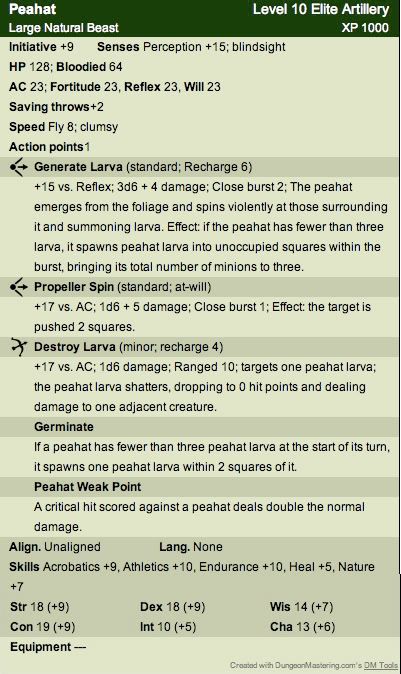
The Peahat is one of the most unique and widely used enemies in the Zelda series, appearing in at least eight different games. My favorite incarnation is the large, larva spewing Peahat from Ocarina of Time, which you will find below converted to a 4th Edition DnD monster.


Peahat

The Peahat is a common sight in large flat expanses of land, giving them plenty of room to fly around and patrol their territory for invaders. At night they root deep into the ground but will still attack if provoked.

Peahat Tactics
Once it senses that outsiders are near, the peahat will spiral out of the ground using its generate larva power to damage the foes and summon its minions. It has little regard for the welfare of the larva and will use its destroy larva power whenever possible. When an opponent scores a critical hit on the peahat it has effectively attacked its unprotected roots, which are usually well protected by its rapidly spinning, propeller like blades.

The peahat larva will try to surround a foe to increase their chances to hit using their circling strike power. The peahat will use destroy larva on the one not flanking an opponent.


Peahat Lore
A character knows the following with a successful Nature check.

DC15: Peahats are common in flat fields and
are very territorial. Once disturbed they will germinate larva to help defeat the intruder.

DC20: Peahats can spawn an endless supply of larva and will not cease until they are destroyed or the outsiders have left the area.


*The Legend of Zelda is property of Nintendo