Showing posts with label 4e DnD. Show all posts

Wednesday, January 13, 2010

Kobold as a 4th Edition Player Race

*Illustration by Christina Hans, aka avadrea on Deviantart.com.


[Below is a write up of the kobold as a player character race for 4th Edition DnD]

KOBOLD
Small and crafty soldiers,
through their veins runs the blood of dragons.

Racial Traits
Kobolds have all the racial traits listed in the back of the Monster Manual, with the following changes:

Vision: Low-light

Elusive Target: You gain a +1 racial bonus to Reflex.

The chosen children of Kurtulmak, kobolds live in in cavernous labyrinths chiseled out of the side of mountains or carved from underground. Their homes are heavily defended with good use of terrain and deadly traps.

Physical Qualities
Standing about 3' 8" on average with slim, wiry bodies, Kobolds are covered in fine scales of green, tan or red. Their red or yellow eyes have the remarkable ability to pick out details in the dimmest of light, Their face is dominated by a lizard-like snout with foward-facing nostrils and remarkable red or yellow eyes that can pick out details in the dimmest of light. Finally the skull is adorned with small vestigial horns, and ear holes...much like the dragons they claim as relatives.

Hatching from eggs, Kobolds reach adulthood at the astonishing rate of seven years. Although violence keeps most kobolds from reaching a venerable age, they are capable of living well past one hundred years.


Playing a Kobold
Kobolds are taught to do one things from the moment they are born, survive. This trait makes many see the kobold as a cowardly species, but in truth kobolds have a cautious and tactical mind that constantly weighs the pros and cons of any action in an attempt to come out on top. They also learn to take pride in their heritage as the chosen servants of dragonkind. Dragonborn may boast of their great kingdom of Arkhosia, but kobold's know that they were made by Kurtulmak himself to defend dragonkind after the dragonborn empire failed.

It is this alternating feeling of pride and powerful survival instinct that makes kobolds the people that they are. Kobolds learn to work in tandem with others of their tribe to accomplish great tasks that no single member of the tribe could, at the same time each kobold tries to do better than his peers in an effort to prove his worth to those around him. This makes kobolds one of the most industrious races. However, these bonds dissolve when danger presents itself, because each kobold is ultimately looking out for his own best interest. A mantra of "better you than me" ensures that the craftiest, most intelligent, and skilled kobolds survive to sow the seeds for the next generation.

Kobolds who go seeking adventure are usually outcasts, often filled with an inordinate amount of pride who wish to make a name for themselves apart from their tribes.

Kobold Characteristics: Agile, crafty, cunning, hard-working, industrious, organized, proud, sly, tenacious, tricky

Male Names: Albrik, Dakarnak, Deekin, Korish, Meepo, Mekrit, Mokumok, Pun-Pun, Riphahn, Sithik, Tunark, Urzican, Vavgor

Female Names: Asiph, Aupinom, Dinsa, Ixinmerik, Kiszar, Kitrak, Liriss, Minaph, Quanip, Sabahn, Sefima, Sysix, Zalicka

Kobold Adventurers

Three sample kobold adventurers are described below.
Krit the Kobold is a traveling rogue and trapsmith. By constantly pitting himself against the work of others he hopes to collect enough research to perfect his craft. Wearing a small leather jerkin and wielding daggers he collected off the corpse of a fallen adventurer Krit travels into the deepest dungeons with his companions, scouting ahead and taking notes on any hazards they encounter.
Tarkin is a kobold warlord who along with his allies travel the ruins of Arkhosia, gathering artifacts belonging to dragons. Someday he hopes to build a new empire for the dragons, this time under the vigilant protection of his people. With his mighty dragonscale shield in front, he is prepared to face any foe.
Kitrak is a mighty sorceress. She comes from a long succession of wild mages, and although she could easily take up a position ruling her tribe she has decided to travel the world in the hopes of gathering even more power. If she comes back to her people, it will be with the deep understanding of the arcane arts.

Thursday, November 12, 2009

4th Edition Dnd Races of Zelda: Rito


Rito

RACIAL TRAITS
Average Height: 5'4" - 6'0"
Average Weight: 140-200 lb.

Ability Scores: +2 Dexterity, + 2 Charisma
Size: Medium
Speed: 6 squares
Vision: Low-light

Languages: Hylian [Common]
Skill Bonuses: +2 Acrobatics, +2 Perception
Light on your Feet: You can shift in difficult terrain
Aerial Acrobat:
You gain a + 1 bonus to your Reflex Defense
Rito Flight: You can use Rito Flight as an encounter power


Play a rito if you want...
◆ To be able to take to the sky above your foes
◆ To be a member of a close knit tribe that reveres a powerful dragon
◆ To be a member of a race that favors the bard, sorcerer, and rogue classes

Physical Qualities:
Ritos are very bird-like in appearance, and are believed to have evolved to their current state from another race. Their most prominent features are their large yellow beaks where a human's nose might be and an expansive set of wings under their arms. These wings fold and tuck neatly when not in use and are usually off-white with brown at the tips of the feathers. All Rito have red eyes and can have pale to tan skin, and white, brown or red hair, though white is the most common. They also have very small pointed feet like those of a bird, with small but still capable talons. Rito often wear lose, colorful robes which do not constrict their movement or flight. They wear few other adornments other than a belt and a bag to carry things while in flight. White, reds, golds and browns are popular colors in their garb and homes.

Playing a Rito:
The Rito live outside of the cities in mountainous terrain and can convert caves or low cliffs into suitable dwellings. Young Rito are called fledglings before they have gained the ability to fly. When they are ready, a fledgling will undertake the journey to the lair of the Rito patron exarc, the sky spirit Valoo. Once there Valoo bestows upon the fledgling one of his scales, which enables them to grow wings and fly. This is the Rito's most time-honored tradition and to refuse to go to Valoo, either from fear or inability, brings great shame to a Rito. Most Rito can only fly a short distance before becoming fatigued, but some more experienced and older Rito can fly over long distances and even carry other small humanoids for a short time. The Rito follow a tribal leader who is generally appointed by bloodline but they do not follow many strict laws other than cultural traditions. Rito are very competitive and will devise games to challenge themselves mentally and physically and compare their relative strengths.

Rito histories speak of a time when the race was flightless and had to use ropes and other tools to navigate the dangerous mountain terrain. Then the Rito found the sky spirit Valoo, who appeared as a gigantic and fearsome red dragon. Valoo granted the Rito his magical scales so that they may take to the skies like himself. Thus, the Rito are extremely grateful and reverent towards Valoo and would never think to disrespect him. The tribe will appoint a young female to serve as Valoo's attendant, to ensure that all sacred rites are performed perfectly. Traditionally the attendant will spend most of her time near Valoo and play the harp to calm his easily tripped temper.

While they do not live with other races, Rito enjoy traveling and have a penchant for becoming messengers due to their ability to cover vast distances quickly and without many provisions. Rito may seem aloof at first, but they quickly warm up to others who are friendly towards them and will welcome them into their homes. Many Rito are trained in combat from a young age, as they find it is best to always be prepared for any kind of attack. A good portion of the tribe will serve as guards to protect the Chieftan, the fledglings and the entrance to Valoo's lair. Even in small numbers the Rito are very capable at defending themselves and their homes because of their constant competition with each other to become better warriors.

*"Skett and Akoot" Original art by Hillary Esdaile, check out her website and deviantart page!

Rito Characteristics: carefree, loyal, competitive, perfectionist, traditional, outgoing, reverent

Example Rito Names:
Male: Akoot, Basht, Hoskit, Ilari, Koboli, Namali, Pashli, Skett
Female: Beroke, Dakapo, Eliji, Harmonee, Kadenz, Kapela, Oktev, Opari

Examples of Rito in the Legend of Zelda: Medli, Komali, Quill, Rito Chieftan

Background and History in the Points of Light Campaign Setting:
No one remembers what the Rito were like before the great dragon Valoo settled in their region, but what is known is that rather than rely on dragonborn or kobolds for protection and company, Valoo elevated a fledgling race into what is now the modern Rito. For the gift of flight, and his ultimate protection from the dangers of the world outside their mountainous homes, the Rito care for and faithfully serve the dragon Valoo. When other races were striving to build and maintain vast empires, the Rito sought only to exist, in peace with themselves and the land around them. Recently however, with darkness pushing in on the boundaries of their land some Rito have begun to leave their ancestral homes. Envoys for peace and travelers seeking to unite the various points of light, the path these Rito travel may just end up protecting their home and traditions, but forging a pact that will ensure the safety of various humanoids and their homes.

Rito Lands in Points of Light Campaign Setting:
Most Rito live in a mountain range dominated by an impressive volcano. They create homes in hallowed out bedrock and caves in the mountains. They use the surrounding lands around their home for harvest and consider it as much their home as the rocky croppings from which they keep their vigil. While non Rito are welcome in Rito territory they may find various portions of their lands inaccessable without the ability to fly or an impressive skill at climbing.

For more information about the Rito: http://zelda.wikia.com/wiki/Rito

The Legend of Zelda and all official images are property of Nintendo

Sunday, October 25, 2009

4th Edition Dnd Races of Zelda: Hylian

Over the following weeks I will be posting descriptions and racial traits for the most famous and best loved races in the Zelda Universe. I'll start today with the most obvious and famous: the Hylians, a race that is distinctive and apart from humans. More races will follow (including Gorons, Zora, Shiekah, Gerudo and many others!) as well as sample characters to match various campaigns in the Zelda Timeline. For now, you can simply insert these races to flavor your current 4th edition campaign and add more options for your players without buying additional supplements. Enjoy!


Hylian

RACIAL TRAITS
Average Height: 5'8" - 6'4"
Average Weight: 135-220 lb

Ability Scores: +2 Wisdom, + 2 Charisma
Size: Medium
Speed: 6 Squares
Vision: Normal

Languages: Hylian [Common]
Skill Bonuses: +2 Insight, +2 Religion
Goddesses' Protection: You have resistance radiant equal to 5 + 1/2 your level
Chosen People: You gain a +2 bonus to death saving throws
Alleviating Strike: You can use alleviating strike as an encounter power


Hylians are known as "the chosen people" of Hyrule. With their divine gifts, they excel at magic and leadership. This tends to make them very proud and many believe that humans are jealous of their favored status.

Play a Hylian if you want...
  • To have a proud heritage and strong connection with the gods
  • To have a burning ambition and strong belief in your own destiny
  • To be a member of a race that favors the cleric, paladin, invoker and avenger classes
Physical Qualities:
Hylians look very much like Humans except that they have protruding pointed ears as their main identifying feature. It is said they have longer ears so that they can hear the voices of the gods. Hylians tend to be taller and slimmer than the average human, with well defined bone structure and exceptional grace. Hylians also tend towards fair skin, blonde or red hair and blue eyes but can have any of the colors of the Human spectrum in addition to some rare members having unnatural shades such as purple or blue hair.

Hylians wear simple clothing with bright elaborate embroidery often displaying sacred and historically significant images. Regal blues, purples and pinks are common. Females wear an abundance of intricate gold jewelry with the triforce, the symbol of their godessess being most prominent.

Playing a Hylian:
Hylians tend to live in cities near the centers of power and are often in charge of local affairs or at the very least involved. They live simply and practically but that does not mean that they don't enjoy the finer things in life without being gaudy. Hylians can have a wide variety of professions but they excel at artistry and crafting. Due to their natural affinity with handling animals they also tend to raise and breed them and horses are an especially important part of their lives.

Hylians believe that they were particularly created by the three Goddesses which they worship: Din, Farore and Nayru. Each chooses one of the three Goddesses and the virtue she embodies (Power, Courage and Wisdom respectively) from a young age as a paragon to guide them. Hylians who venerate Din seek power in different forms whether it be physical, magical or political. They are very driven and will constantly try to increase their power for good or ill. Strong willed Hylians tend to choose Farore and try to live their lives without fear. They will charge into battle and refuse to yield no matter the odds and believe that with Courage they can accomplish their goals. Scholarly and intelligent Hylians honor Nayru as well as nobles, guards and leaders because she is said to have created the rule of law and reason. These individuals use their wisdom to lead, explore magical arts, heal the sick, and adventure to discover truth. Nothing will stop them in their quest for greater knowledge and they constantly seek to educate those around them.

Because of their belief in themselves as a chosen race of the Gods, Hylians tend to think lesser of the other races but that does not necessarily mean that they hate or subjugate them. Few Hylians take to outright xenophobia and most of them behave friendly and charitably to others, if perhaps too self-important. They live and work most often with Humans, being the closest to them physically, but they will adventure with most any of the traditionally benevolent races happily (Eladrin, Elves, Halflings, Dwarves, Gorons etc.) and are suspicious of the more violent and rare species (Dragonborn, Tieflings, Gerudo, Orcs, Moblins etc.)

Hylian Characteristics: proud, diplomatic, devout, valorous, charismatic, intuitive, idealist

Example Hylian Names
Hylians use simple one or two syllable names which are often passed down or significant in meaning
Male:
Auru, Fyer, Grog, Kafei, Mesa, Orca, Sakon, Shad
Female:
Agitha, Aryll, Astrid, Marin, Telma, Tetra

Examples of Hylians in the Legend of Zelda: Link, Zelda, Malon, King Daphnes Nohansen Hyrule, Anju

Background and History in the Points of Light Campaign Setting:
Around the campfires of the world and the hearths of city taverns stories are told of the magical kingdom of Hyrule. The land of Hyrule was both beautiful and bountiful, and blessed with peace. But of course, that peace would one day be shattered. A powerful villain arose and against his power the Hyrulian kingdom could not stand. Finally the Goddesses had to intervene, and buried the villain underneath a torrent of water, so much that the great kingdom of Hyrule sank beneath the waves.

Few Hylians alive truly remember what it was like to live in Hyrule, having had so many generations pass since the nation fell, but they do remember the glory of it. Filled with pride over their history, there is a saying that Hyrule will always exist in the hearts of her people.

Hylian Lands in Points of Light Campaign Setting:
Hylians have no land in the Points of Light, and are a rare sight in the vales. They often share lands with humans, although there exists the rare Hylian village or city district. These Hylian areas are filled with majestic architecture and fine craftsmanship in an attempt to pay homage to their glorious past, but they are an exception rather than the norm.

For more information about Hylians check out: http://zelda.wikia.com/wiki/Hylian
For more information about the Goddesses: http://www.zeldawiki.org/Goddesses

The Legend of Zelda and all official images are property of Nintendo

Tuesday, October 20, 2009

Dungeon Brew Reviews: Martial Flavor


[The following article is part of the Small Press Week blog carnival being run by RPG Blog II. Many bloggers are coming together for this event to check out some of the great things about, and coming out of smaller rpg publishers. If you'd like to see what the other bloggers have covered this week, drop by Moebius Adventures for a complete list of links.]

Chaotic Shiny Productions
was nice enough to send me an advance copy of their upcoming title Martial Flavor, and I'd be remiss if I didn't share what I've learned about the book. Keep in mind while reading this that the book still has sometime before publication and is still undergoing some revisions and enhancements.

The Good Vs Evil Axis

Martial Flavor is a unique book detailing five martial traditions for use in your 4th edition D&D campaign. Each Chapter details a martial tradition, complete with backstory, feats, and new powers.

The Good
This book is presented in an easy to read format, with each new chapter detailing one of the five traditions, and taking us from backstory and hierarchy all the way to which 4th edition races interact with the tradition and how. This is followed by example adventurers, and new mechanics for making the organization come alive at the game table. The fluff and the crunch in this book is balanced amazingly well, with plenty of things both GMs and Players can grab onto and spin into interesting plot points and defining features. As I read through the book I couldn't help but think about how great it would be to play a Daikort Mercenary or a Legionnaire. Each chapter brings the tradition to life with in depth background, various examples of members, how they dress, and how their society views both themselves and in many cases the world around them. I was reminded of why I own so many roleplaying books, many of them are just as entertaining a read as a they are a useful resource.

Martial Flavor is a proud addition to that design philosophy. How many times have I looked through my Martial Power book and wished it went into greater detail on what it meant to be a fighter? Well, Martial Flavor offers plenty of material for that. With this book in hand you never have to worry again about your ranger looking like any other ranger. Make the character stand out, make him a Fox in a Daikort Pack, picking his way through a shady marshland with the greatest of skill. Perhaps what is so great about this book is that it not only helps you create unique characters, but it gives you in game mechanics to make those decisions actually mean something. For example if you are an Ellesin fighter, then you are the king of mounted combat, able to take brand new feats and powers to reinforce just how good you are at mounted combat.

The Evil
I know it is a growing trend with RPG book these days, but this book just doesn't have an index. The bookmarks in the pdf are amazing, but I'm one of those weird individuals who likes to print off his pdfs for long perusals in the sunlight. Beyond that, I have one word to share with you: Background. The backgrounds in this book are more akin to those that appeared in Dragon for the Scales of War (SoW) adventure path. As such they are a little more powerful than the streamlined system that is presented in the Player's Handbook 2 and Eberron Player's Guide. That having been said, some of the backgrounds even blow their SoW cousins out of the water. Chief among these is the Ikanoi, which gives you cold resistance equal to either Wisdom bonus or Constitution bonus whichever is lower, and as such is definitely something that could level with you, especially if you are playing a shaman. Compare that feature with the Sijara's background which gives them Bluff and Diplomacy and class skills and +1 to each and you see some variance in background utility even amongst the book itself.

Bang For Your Buck

So you are thinking about picking Martial Flavor up from Chaotic Shiny. Well, it retails for 19.95 so lets take a moment and examine what you get. In this 56 page tome of a gaming pdf you get an astounding 88 feats, which cover both Heroic and Paragon tier, as well as new Multiclass feats. Some of you may be wondering why one would need new multiclass feats, so be amazed because this book has 12 alternative class features to further customize your martial warrior. You also get several new utility powers for your martial classes that really flesh out how your martial warrior is different from your typical Points of Light model. But lets go back to those feats because there is one thing I'd really like to point out. A whole slew of those feats are for characters who excel at Mounted Combat, and some of the new powers and alternative class features help support the concept. If you have EVER wanted to play a mounted character in D&D 4e, then this is the book to buy, even if you don't use the tradition that goes with them. Heck, even if you want to have a mounted character from a different power source, you will find what you need in those feats. Though obviously if that's all you want you may want to look elsewere for your mount fix.

Now, what if you are a GM? Well, then this is still a pretty good resource for you, although admittedly you are missing out on some of the fun by not being able to play any of the neat new character concepts this book helps deliver. But that doesn't keep you from introducing the Legionnaires of Arytis, or throwing your part against a well trained Daikort Pack. You can easily stat out some great NPCs that will ride both sides of the ally/enemy fence. I know I keep talking about them, but I myself will be dropping the Daikort into my home campaign, they are just too great of a DM tool to not use, and the bevy of information on each tradition gives you what you need to not only run adventures featuring these warriors, but entire campaigns built around them.

The Final Verdict
If you have a martial character, or you plan on playing one then this book belongs on your digital bookshelf. The sheer number of new feats and powers and other goodies contained therein means you WILL find something of use even if you never use the martial traditions that are linked to them. As just one example you can easily mine out the entire mounted combat tidbits (like the Mounted Fighter talent and the list of racial rider feats) and use them as is. As for GMs, since the GSL came out I've purchased my fair share of products, and I haven't seen many that come to the level of dedication, balance, and just plain cool things to put in your game. The text is well written and evocative, the sidebars are placed well and are informative. Here's the gist of things, if I was to write about all the great things in this lengthy pdf I would have to go on for pages, because there is so much great material contained within.

All of that having been said, I can understand if the price tag turns you off of the book. In today's market, and especially without having seen for yourself just how much material is packed in here it can be tough to make that kind of commitment. Comparatively though, this is essentially five products at $4 each. Each one containing about 22 feats, plenty of utility powers and other tools and material to boot. Thinking of it that way makes the price make a little more sense. That having been said, if your interested, but just haven't made up your mind yet you can see a few excerpts at this page of Chaotic Shiny's website. In my opinion you should save up some cash and mark November 1st on your calendar so you can be one of the first to spice up your adventuring life with some Martial Flavor.

Sunday, September 20, 2009

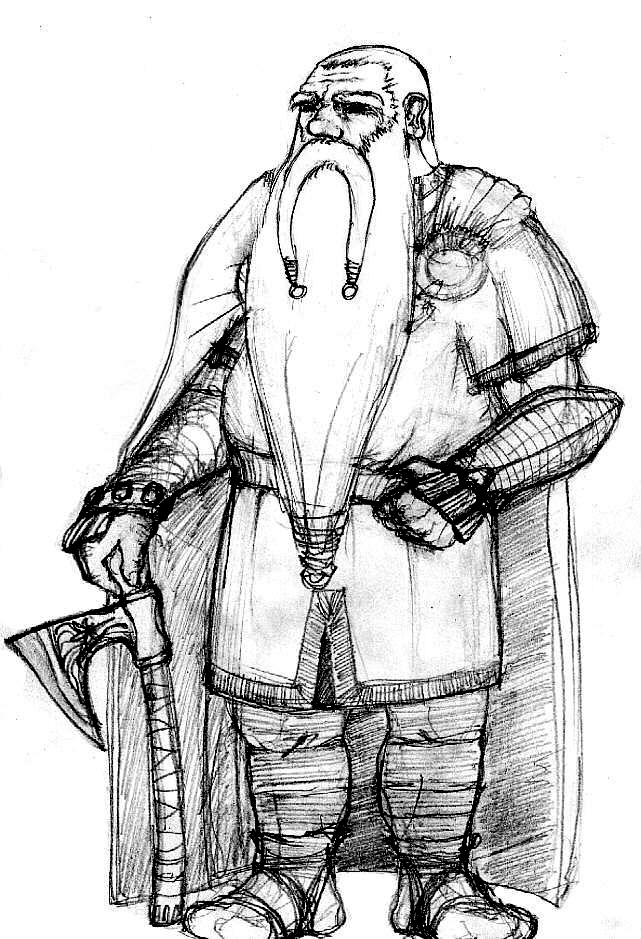
Pick Up PC, Eberk Ironshield: Dwarven Fighter

[Below you'll find the second of five Pick Up PCs for eleventh level play, each one can be downloaded and opened using the D&D Character Builder program. All five are from the Eberron campaign setting, although they can easily be ported to another campaign world if needed.]

Download Eberk Ironshield for use with the DDI Character Builder

Download Eberk Ironshield in PDF format

Background

Eberk Ironshield, son of Eramus, son of Dorahn, current head of the Ironsheild family is Evard the Explorer's elder brother and devoted bodyguard. When the two were young Eberk trained all day long everyday to become a mighty dwarven warrior, he studied tactics, went through rigorous physical excersize, and sparred with the most skilled dwarves Stormreach had to offer him.

This life of martial discipline was ended prematurely when his brother Evard disappeared into the twisting tunnels of a Stormreach sewer. Eberk abandoned his routine, and began the search alone. Things were grim until he found Khava, a dragonborn from Argonnessen who traveled to the city to find her destiny.

She led Eberk through the sewers, and along with a few of Eberk's warrior companions they freed Evard from the grip of a clan of hobgoblins. From that point Eberk vowed never to let Evard go off by himself again.

Goals

Eberk lives to protect his brother from harm, to bring honor to his family, and to perfect his skills in the art of war. Of course, Evard's whimsical nature usually makes it hard to find time to practice, and running from place to place hardly increases the clan's holdings. Because of this Eberk often finds his brother's antics taxing, even as he resigns himself to the half-brained schemes. He is first and foremost an older brother, but more than that he is an honorable and brave dwarven warrior.

Mannerisms

Eberk is brave, somber and collected. Although he rarely talks or draws attention to himself, he is always listening and watching, constantly assessing the situation. Evard is a selfless and confident man who expects more from Evard and his companions than they often give him. Strive to lead by example, become a paragon of hard work and a champion of the moral high road.

Combos

Crushing Challenge
With this technique there is only one way to escape Eberk's attacks, death itself.

The Setup
Eberk must be within five squares of the opponent and have a straight line of travel available.

The Execution
1st: Eberk charges towards the enemy using Shield Bash
2nd: Eberk uses his move action to close with the enemy.
3rd: Eberk uses an action point to attack the opponent with Blinding Smash
4th: On Eberks next turn attack the opponent with Pinning Smash.
5th: Obliterate your opponent.

Using Eberk in your Campaign


Eberk can easily be used in a campaign other than Eberron, other than his city of origin there is nothing in his character that ties him overtly to the continent of Khorvaire.

Using Eberk as an NPC


As a DM you can use Eberk as a skilled bodyguard, either protecting a prominent ally of the PCs, or more interestingly a hated rival or enemy. With Eberk's vast amount of healing abilities (a second wind that restores 50% of his health, and two dailies that allow him to heal on a successful attack) Eberk could easily become a reoccuring opponent who will quickly become a thorn in the PCs side.

Saturday, September 19, 2009

Pick Up PC: Evard the Explorer: Dwarven Artificer


*Art by Storn A. Cook, used under Creative Commons

[Below you'll find the first of five Pick Up PCs for eleventh level play, each one can be downloaded and opened using the D&D Character Builder program. All five are from the Eberron campaign setting, although they can easily be ported to another campaign world if needed.]

Download Evard the Explorer as a DDI Character Builder file
Download Evard the Explorer as a PDF file

Background

Evard the Explorer is a dwarven artificer from the city of Stormreach. When he was a child and his older brother Eberk was learning the dwarven arts of combat, Evard was always off exploring the city, sometimes wandering into the dangerous sewers beneath the city. It was during one of these forays that Evard found his love.

Inside one of the many twisting passages that makes up the Stormreach sewers Evard found a tunnel leading to an ancient Dharkanni ruin, filled with mysterious artifacts and ancient architecture. Evard was enamored, and hardly noticed the hobgoblins sneaking up behind him.

Eberk saved him, leading a foray of warriors into the sewers they tracked him with the help of a dockside tough named Khava. From that point, Eberk never took his eyes off Evard. Unfourtunetely for Eberk, Evard had a taste of adventure and history and would never be the same.

Evard poured himself into the study of ancient arcane arts, and history. He lent his services to those who would take him on their quests, and quickly found regular employment with the Morgrave University, exploring ruins both on Khorvaire and within the deepest jungles of Xendrik.

Goals

Evard is fascinated with history and the arcane. Sadly he has no long term goal in mind, but floats from job to job and place to place enamored with the wonders around him. For Evard life is about adventure and nothing speaks to him more than the glorious remains of the past.

Mannerisms

While playing Evard feel free to break dwarven stereotypes. Evard isn't somber, he isn't concerned with honor or his family's respect. Evard is a flighty, curious man who is willing to endanger himself (and by extension his allies) to find a shred of interesting lore on a forgotten culture.

Despite the problems his work encounters (or creates) Evard stays optimistic, certain in his safety even as he is seperated from the surface world by collapsing ruins. This is largly due to his older Eberk always being around, and if Evard finds himself alone if is highly likely that the situation would chip away at his happy demeanor.

Combos

Shatter the Shell
This move allows Evard to pound on an enemy as efficiently as any frontline warrior, perhaps even better.

The Setup
Make sure you are within ten squares of the enemy, but with no other opponents adjacent to you.

The Execution
1st: Attack the opponent with Altered Luck, and since you are within range give yourself a +2 to your next attack.
2nd: Spend an action point and attack the opponent with Brittle-Skin Missile
3rd: At the end of this turn, or the start of the next turn close with your opponent and start attacking with Aggravating Force, giving you a continuous +2 to hit with your next attack. Also, since you have White Lotus Enervation, they take a -1 to their AC until the end of your next turn.
4th: Continue step 3, enjoying your +3 to hit and +5 to damage.

Using Evard In Your Campaign

Using Evard in a different campaign doesn't require much of a change, just rework his background to be another city, and instead of Dharkanni ruins, he discovers a different ruin left by a group in your campaign world.

Using Evard as an NPC

Evard could make for an interesting employer for the PCs. Hiring them for protection and then occasionally putting the party in danger "In the name of research".

Alternatively, if the party has a habit of exploring ruins Evard and his friends could be reoccurring rivals, constantly striving to do things faster and better than the PCs.

Saturday, August 22, 2009

VG Meet DnD: Sorceress Sisters Twinrova from The Legend of Zelda: Ocarina of Time


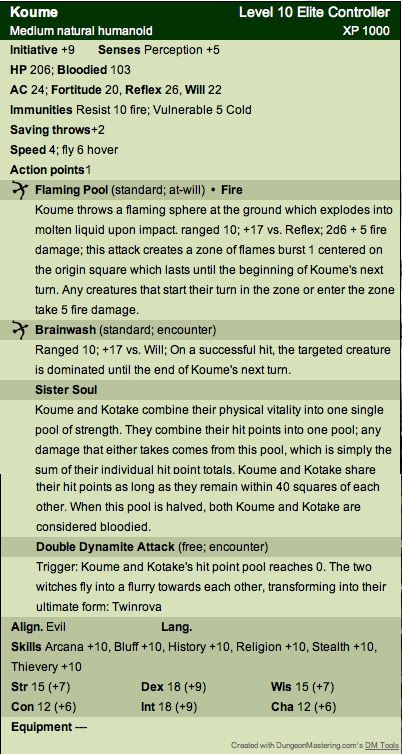
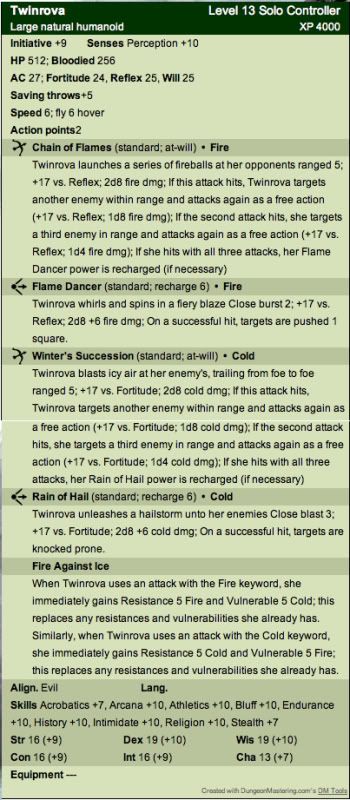
The "Sorceress Sisters Twinrova" or just Twinrova, refers to the iconic boss battle including the evil witches Koume and Kotake and their fused form Twinrova from the Spirit Temple in Ocarina of Time. Considered one of the best by fans of the series, Koume and Kotake use their opposing Fire and Ice abilities which must be reflected back unto them. What makes the battle so memorable, however, are the little nuances in the witches personalities which come alive while fighting them. From their opening cryptic words, Twinrova's embarassing wink, to their petty bickering at their defeat, these characters make great villains and an epic solo battle. The stats below (using Koume and Kotake followed by Twinrova) make up a solo level 15 encounter.


Koume
"With my flame, I will burn him to the bone!"

Koume is an ancient evil witch with powerful fire magic. Along with her twin sister, Kotake, they are collectively known as Twinrova.

Koume Tactics

Koume will want to remain in the air on her broomstick, as she is old and slow on the ground. In addition this will keep her out of harm's way from powerful melee fighters and allow her to manuever around freely to use her Flaming Pool power. She will want to use her Brainwash power on a weak willed but physically strong character. When Koume and Kotake are utilizing their Sister Soul hit point pool, both witches will physically flinch when one is attacked, as it is damaging both. Koume may also use her high Bluff skill to try and trick the party and feign surrender, using her high Stealth to launch a surprise attack.


Kotake

"With my frost, I will freeze him to his soul!"

Kotake is a decrepit evil sorceress with potent cold magic. Along with her twin sister, Koume, they are collectively known as Twinrova.

Kotake Tactics

Kotake prefers to take to the air for better maneuverability and to stay out of reach of melee combatants. She will use her Ice Sheet power whenever possible to keep her enemies still and make better targets for Koume's Flaming Pool. Kotake will use her Brainwash power on a weak willed foe soon after Koume as she will become jealous of her sister's slave and will want to make one of her own. Kotake may also use her acute Insight to play on her enemies' fears followed by Intimidate or Diplomacy to get her way.


Koume and Kotake Lore

A Character knows the following with a successful history or religion check

DC20 Koume and Kotake are ancient witches known for trying to resurrect evil deities to do their bidding. It is said that the two could raise massive armies of brainwashed men and women.

DC25 The two witches were often referred to collectively as Twinrova in historical/religious texts

A Character knows the following with a successful arcana check

DC20 Koume and Kotake are powerful sorceresses commanding the powers of fire and ice, respectively. It was thought that the two could merge into a more powerful ultimate being using their dark magic.

DC25 The amalgamate form of Koume and Kotake was called Twinrova


Twinrova

Twinrova is the result of Koume and Kotake's Double Dynamite Attack. She appears as a large, much younger woman, wielding a rod in each hand: one of flames and one of frost.

Twinrova Tactics

Twinrova may begin the battle using any of her abilities, depending on the formation of her enemies. If they are scattered around in all directions she will use either her Chain of Flames or Winter's Succession powers. If they are surrounding her closely she will drop to the ground to use her Flame Dancer power. Finally, if they are all in front, grouped closely together, she would use her Rain of Hail. Once her Flame Dancer and Rain of Hail powers are expended she will attempt to recharge them using Chain of Flames and Winter's Succession. Keep in mind her Fire Against Ice which will switch her resistances and vulnerabilities based on which type of attack she last used. The party may figure this ability out after a few trial and error rounds and use it to their advantage--if she is hit by the type she is resisting she will brush the attack off quickly but if she is hit by her weakness, she will cry out sharply.

Twinrova Lore

A Character knows the following with a successful history check

DC25 Twinrova is the fused entity of Koume and Kotake. The two witches are said to don this form only when they have no other choice. According to legend, Twinrova is impossible to defeat because of her shifting weaknesses and strengths.

A Character knows the following with a successful arcana check

DC25 Twinrova is the fused entity of Koume and Kotake. She uses both fire and ice magic and is said to be more powerful than the two witches are separately.


Using Twinrova in your 4th Edition DnD Campaign

Koume and Kotake, with their oddball personalities and penchant for brainwashing innocent bystanders, make a great recurring villain for a heroic-paragon campaign. The characters may first encounter the witches at a lower level where they fight one or both of them for a while before the witches flee into a portal, cackling with glee. The witches' ultimate goal may be to resurrect an evil deity or aspect of a deity, such as Orcus or Nerull. A close friend of the party may become brainwashed by the duo or could have been brainwashed from the start. Finally, at 15th level the party will be able to take care of them, feeling a great sense of accomplishment from defeating an ancient evil.


**The Legend of Zelda is property of Nintendo


Sunday, August 16, 2009

VG Meet DnD: The Rope from The Legend of Zelda


The snake-like Rope first appeared in the original The Legend of Zelda for NES, and has been used in all the top view 2D Zelda games. The Rope is a great minion for DMs who use a grid battle map in their games. Its linear attack pattern lends itself to a variety of unique encounters and situations either by themselves, or in a group with other monsters.

Rope

The rope looks like a normal snake but is the size of an average humanoid. When they sense an enemy they swiftly charge their aerodynamic forms in a straight line at the creature. They are generally weak, but their tendency to be found in dungeons in large groups makes them dangerous to the inexperienced adventurer.


Rope Tactics

The rope is able to attack a nearby enemy as soon as it moves into range with its unswerving charge power. However, a group of ropes attempting to ambush a party may delay their attacks until they can surround the group. As per usual, a rope may only charge enemies that are at least 2 squares away, and may only charge enemies in a straight square line (*see diagram below). When it is next to enemies it must rely solely on its bite power.


Rope Lore

A character knows the following with a successful Dungeoneering check

DC15: Ropes are snake-like creatures usually found in groups in large open rooms, waiting for an enemy to cross their line of sight so they can quickly charge their prey.


*In order to best explain the limitations of the unswerving charge power I have provided a sample battle situation


Here an adventuring party enters an open room and we will assume do not spot the enemies. Let the R counters be the ropes. Now, all ropes that are able to use their unswerving charge power will do so, interrupting the characters' movement. The charge being made by the ropes is represented by the black arrows. The ropes that do not qualify to use the move will not act until their initiative.

Now we have the setup after the ropes' immediate interrupts have gone off.

As you can see you could combine ropes with different shaped rooms to achieve certain goals, such as trapping the players in a narrow hallway, or pushing towards a more dangerous foe. You could always take a tip from Zelda and simply fill a room to the brim with them for a higher level encounter. The possibilities are endless so enjoy!


**The Legend of Zelda is property of Nintendo


Tuesday, August 11, 2009

VG Meet DnD: The Peahat from The Legend of Zelda: Ocarina of Time


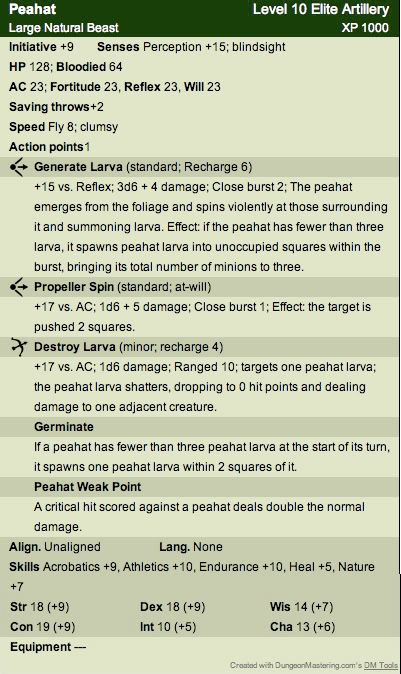
The Peahat is one of the most unique and widely used enemies in the Zelda series, appearing in at least eight different games. My favorite incarnation is the large, larva spewing Peahat from Ocarina of Time, which you will find below converted to a 4th Edition DnD monster.


Peahat

The Peahat is a common sight in large flat expanses of land, giving them plenty of room to fly around and patrol their territory for invaders. At night they root deep into the ground but will still attack if provoked.

Peahat Tactics
Once it senses that outsiders are near, the peahat will spiral out of the ground using its generate larva power to damage the foes and summon its minions. It has little regard for the welfare of the larva and will use its destroy larva power whenever possible. When an opponent scores a critical hit on the peahat it has effectively attacked its unprotected roots, which are usually well protected by its rapidly spinning, propeller like blades.

The peahat larva will try to surround a foe to increase their chances to hit using their circling strike power. The peahat will use destroy larva on the one not flanking an opponent.


Peahat Lore
A character knows the following with a successful Nature check.

DC15: Peahats are common in flat fields and
are very territorial. Once disturbed they will germinate larva to help defeat the intruder.

DC20: Peahats can spawn an endless supply of larva and will not cease until they are destroyed or the outsiders have left the area.


*The Legend of Zelda is property of Nintendo

Saturday, August 8, 2009

VG Meet DnD: The Boomer from Left 4 Dead


[Below you will find a new 4th Edition Monster converted from the popular game Left 4 Dead]

The Boomer

As the shadar-kai who live there know, the Shadowfell is a realm filled with a spiritual malaise that poisons the soul. On some occasions, this disease of the soul reaches through portals to the material plane and infects those who come into contact with it. Those who are greatly affected rise again when they die as undead, with the worst symbol of this taint rising as the vile corruption corpse (see the Monster Manual for further details).

Or so it was thought. Recently a new type of undead has risen up, bloated on the corrupt energies of the shadow fell these odious undead are known as "boomers". Manifesting the affliction of the Shadowfell as putrescent green bile, they soak their enemies in gruesome layers of vomit.

Boomers appear as obese humans in an advanced state of decay, the lower portion of their mouth and parts of their unclean forms bursting from the pressure of the corruption within. Fingernails on both hands have become elongated and their large bellies ripple like disturbed water as they hobble about on
stout legs.


Boomers and Atmosphere

In the game Left 4 Dead you almost always know (and therefore dread) when a boomer is on its way. You can also evoke this sense of apprehension by catering to their sense as a boomer approaches. For instance "As you round the corner an acrid stench of decay assaults your nose and you can hear a faint sloshing sound followed by a strangled gurgling sound. ".


Boomer Tactics
Boomers like to work in concert with a large amount of undead allies in particular they prefer to surround themselves with throngs of zombie rotters (Monster Manual) and their lesser cousins the putrescent zombies (Open Grave).

When they assault a group the boomer opens up with boomer bile and then moves into and along with any undead allies concentrates its attacks on the weakest member who succumbed to the blinding bile. If it recharges boomer bile it will try to target anyone who has either saved from or was not affected by the blinding condition.

Finally, the boomer will gladly throw itself into a prime position for its posmortem explosion if it is running low on hit points.

Boomer Lore
A character knows the following with a successful Religion check.

DC15: Boomers are undead created when mortals die near areas tainted by the presence of the Shadowfell. They channel that corruption into a blinding bile that they spew at their opponents.

DC20: Upon the death of a smoker they explode damaging and blinding those around them.


Thursday, August 6, 2009

VG Meet DnD: The Smoker from Left 4 Dead

[Below you will find a new 4th Edition Monster converted from the popular game Left 4 Dead]

Chances are if you have an Xbox 360 you've heard the buzz around Valve's latest game Left 4 Dead. In the game you take on the role of 1 of 4 survivors who have to work together to overcome the dangers of an environment wrought with hordes of zombies.

The real charm of this game however comes from the multiplayer game type "Versus" where two teams take turns alternating between survivors and a group of special infected.

These special infected are zombies with unique abilities that allow them to better acquire their lunch, namely a survivor sandwich. Today I'm taking a look at converting one of these menacing foes to the new 4th Edition D&D stats.

I'd like to introduce the smoker. In Left 4 Dead this deadly critter has a lengthy tongue that it uses to ensnare prey and constrict it while its buddies beat on the hapless survivor. It gets its name from the cloud of viscous smoke that seeps from its body, a cloud that remains even after the smoker's death.

The Smoker
Life outside of the bright safety afforded by the towns and cities can be a dangerous affair. Farmers and others who live on their own can expect the occasional attack by roving monsters and bandits.

Some particularly cruel bandits have a habit of locking their victims inside their homes while they take everything of value. Before they ride off they light the houses aflame. The victims of these raids often die due to the roaring flames or the choking smoke.

The former often become Blazing Skeletons (see the Monster Manual) while the latter occasionally rise to become the dreaded Smoker. Smokers exist to share their pain and misery by choking the life from living beings.

A smoker resembles in many ways the humanoid it used to be albeit with scorched clothes and flesh. The most obvious feature of the smoker is a seeping green gas that emanates from within its rotting corpse. Although their faces are often hidden by the smoke, those who view past the concealment can see eyes ablaze with malevolence.


Smoker Tactics
Smokers prefer to hide in the shadows or behind cover until a time to strike presents itself. Although largely unintelligent they are possessed of a feral cunning that allows them to ambush unsuspecting prey.

A smoker usually waits for the majority of a group to engage enemies and then tries to maneuver into range for a tongue snare on a target not engaged in melee. They then follow up with a constrict attack. At the start of their next turn they like to use smokescreen followed by two more constrict attacks.

Smoker Lore
A character knows the following with a successful Religion check.

DC15: Smokers, undead created from the victim of asphyxiation from smoke, are powerful zombies with the ability to ensnare and choke enemies with their powerful tongue.

DC20: Upon the death of a smoker they explode leaving a viscous gas that obscures vision.

Thursday, July 30, 2009

Alley Oop: Teamwork Maneuvers in 4e D&D


* This post is part of the RPG Bloggers July Carnival on D&D, organized by 6d6 Fireball

Dungeons and Dragons has always been a game about teamwork, but in the 4th edition of the game it has been kicked up to the nth power. No player is left without a job to do in 4E Combat, and while they all can deal substantial damage by themselves, it is when you start using powers in concert and in certain conditions that the system really starts to stand out.

What is a Teamwork Maneuver?
A teamwork maneuver is any series of actions in combat that is enhanced by the actions of the others, or achieves some goal that it couldn't do by itself. Essentially, a teamwork maneuver is a couple of powers that when used in the right situation and order are greater than the sum of their individual parts.

Teamwork Maneuvers and Roleplay
The Fastball Special is an attack involving the X-men Colossus and Wolverine. Wolverine allows his super strong friend Colossus to toss him like a baseball at an enemy that he may otherwise be unable to reach. The move is so iconic that when Joss Whedon wrote it into Astonishing X-men he didn't even need to use dialogue to explain it.

Your team could have its own special moves, born out of a familiarity with each other and an understanding of the party's strengths and weaknesses. The combination of the cleric's Weapon of the Gods and the fighter's Tempest Dance could be called the Holy Hurricane for instance.

Example Teamwork Maneuvers
I've created a few teamwork maneuvers that you can pull out for your next game session. They all follow the same format:

Name of the Maneuver
Purpose of the Maneuver

Preparation
This section describes what you need to use the maneuver, for instance: 1 lvl 3 ranger, 1 lvl 3 dragonborn paladin with the hurl breath feat.

The Setup
This section will explain what the ideal situation is for the maneuver, and to make it easier I've provided pictures. It will explain what position you and your enemies should be in before using the maneuver, and what effects or conditions have to be active to use it.

The Execution
Here you will find the step by step guide breaking down how to perform the maneuver. Each entry assumes that the last step was successful.

Super Mr Sticky
This move places an annoying enemy near the fighter, severely damaging him in the process.

Preparation
1 lvl 1 Cleric
1 Fighter
A small room with only two possible exits

The Setup
Move the fighter off by himself in the middle of one exit. Then have the cleric move opposite him blocking or near another exit, keeping an enemy between them.

The Execution
1st: Have the cleric use Guardian of Faith, placing the conjuration on the same square as the fighter.
2nd: Have the cleric spend an action point and use Cause Fear, thus
forcing the opponent to attempt to rush past the fighter.
3rd: Wait for the opponent to provoke an opportunity attack from the fighter, then have the fighter attack, hitting the opponent and thus stopping him in place.
4th: The fighter should, known as Mr Sticky, can keep the enemy from moving away from him.
5th: Make an attack with the guardian of faith.
6th: Repeat steps 4 and 5 as needed.


Its Raining Dailys
When fighting a solo you need your daily attacks to hit. If you can pull this move off, it will make hitting with daily attacks a cakewalk.

Preparation
1 lvl 7 Rogue with Brutal Scoundrel, wielding a light blade
1 lvl 1 Warlord with an impressive Intelligence modifier
A party with daily attacks to burn

The Setup
Flank the solo with both the rogue and the warlord, and make sure all allies are within 5 squares of the warlord. Preferably the rogue and warlord should go before the rest of the party.

The Execution
1st: Have the rogue attack with Imperiling Strike, dropping the opponent's AC and Reflex defenses by the rogue's Str Mod (should be at least 3)
2nd: Now that the enemy's defense is down, have the warlord use Lead the Attack, raising all allies' (including himself) attack bonus by 1+his Int Mod.
3rd: Start using your daily attacks, enjoy.

Trapped! By a Burning Chill
Crush your enemy with assured damage every turn.

Preperation
1 lvl 1 Warlock
1 lvl 5 Warlord
1 lvl 1 Wizard
*Either the Warlock, the Warlord, or both have to be tieflings, or otherwise resistant to fire damage.

The Setup
Flank your tough opponent with both a warlord and a warlock, at least one of them should have resistance to fire damage.

The Execution
1st: Have your warlord attack the enemy with Villain's Nightmare.
2nd: Now that your villain is trapped, have your warlock use Armor of Agathys
3rd: Add insult to injury by having your Wizard cast Flaming Sphere, placing it adjacent to both the enemy and the wizard's flame retardant ally.
4th: When the enemy's turn comes up, roll damage for both Flaming Sphere and Armor of Agathys.